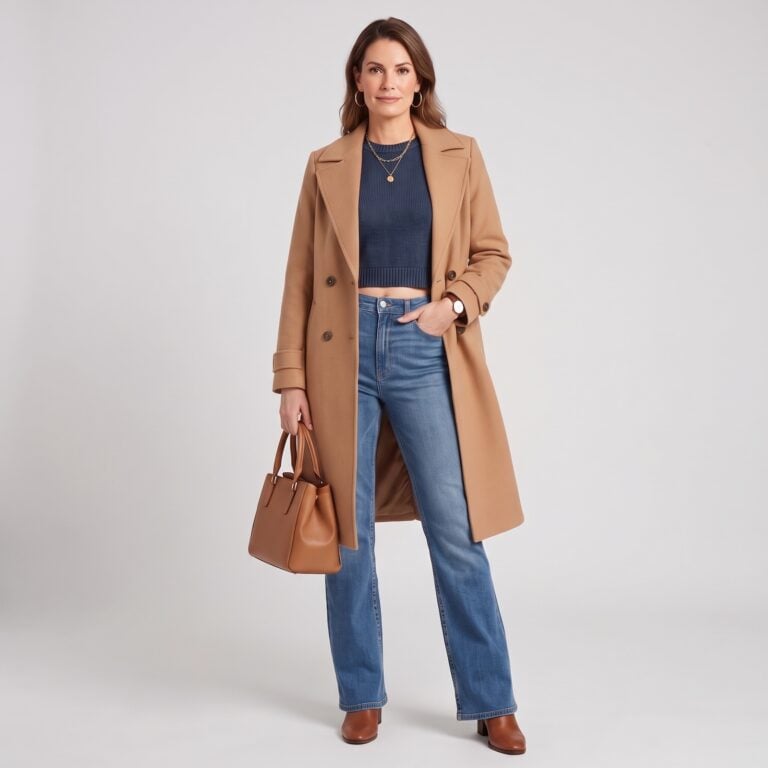

❤️ Would you like to save this?
There is a version of the baseball cap that reads as deliberate, confident, and undeniably cool. And there is a version that reads as a bad morning that never recovered. The cap itself is identical. The difference is not the brand, the color, or even the outfit, it is something subtler, something that registers in the brain of every observant woman before she has consciously processed a single detail. She knows within seconds. You know too, when you see it on someone else. The harder question is whether you know when it is you. The psychology behind that split-second read is more precise than you would expect, and understanding it changes not just how you wear a cap, but how you think about getting dressed entirely.
FYI, thanks to AI imagery software, we’re able to create very specific fashion and hairstyle examples to illustrate the points being made. In some cases, imagery is exaggerated to hammer home the point. Also, assume links that take you off the site are affiliate links such as links to Amazon. this means we may earn a commission if you buy something.
The Psychological Signal Your Hat Sends Before You Say a Word

Every piece of clothing broadcasts a message before you open your mouth. The baseball cap is no different, except that its signal is unusually loud and unusually binary. It says either I chose this deliberately or I ran out of ideas. There is almost no middle ground, and observers read it instantly.
This is the phenomenon psychologists call enclothed cognition, the idea that clothing carries symbolic meaning that changes how both the wearer and observers interpret a situation. According to (Source) published in the Journal of Experimental Social Psychology, what a garment symbolizes is just as powerful as whether it is worn at all. A cap worn as a shield, covering unwashed hair, excusing a half-finished outfit, takes on the symbolic weight of retreat. A cap worn as a deliberate accessory takes on something entirely different: control, ease, intention.
The cap itself is neutral. But your relationship to the cap is not. And that relationship is exactly what other women are reading, before you’ve said a single word. The question worth sitting with is: what does yours say?
Why Other Women Clock the Difference in Under Three Seconds

Here is the unsettling truth: the woman across the coffee shop has already assessed your cap situation before she’s consciously registered anything about you. This isn’t judgment so much as biology.
Psychologists call it thin-slicing, the brain’s ability to extract accurate social meaning from tiny fragments of information. According to research published by (Source), people form surprisingly accurate impressions from observations lasting just seconds, and those impressions often match judgments made after far longer exposure. More pointed still: Ambady and Rosenthal’s 1992 meta-analysis of 38 studies (Source) found that accuracy was unrelated to the length of the observation. Five seconds and five minutes produced the same read.
What makes women particularly sharp at this particular read? Experience. Women who have worn caps apologetically, and most have, at some point, know exactly what that energy looks like from the outside. She isn’t judging you. She’s pattern-matching. And the pattern she’s scanning for has nothing to do with the brand on the cap.
The Makeup Rule That Turns a Cap From Camouflage Into a Statement

There’s a very specific read that happens when a woman walks in wearing a baseball cap with a completely bare face. It isn’t “effortless”, it registers, on a subconscious level, as concealment. The cap, the absence of any beauty signal, the body language, they stack into a single message: she didn’t want to be seen today. And observant women clock it instantly, because most of them have been there.
This isn’t about requiring full makeup under a hat. It’s about signal theory. Research published in a peer-reviewed review in the International Journal of Advanced Research (Source) describes what researchers call the “makeup effect”, a documented pattern where even minimal cosmetic application shifts self-perception toward confidence and engagement. The mechanism matters: the cap itself is neutral. What surrounds it tells the story. A tinted moisturizer and a defined brow signal “I looked in the mirror this morning.” A single swipe of tinted lip balm signals the same. Neither requires effort, they require intention. And intention is exactly what the cap, worn alone, tends to erase.
The psychology is precise here. A 2022 study published in PLOS One (Source) found that makeup usage was more strongly predicted by social self-esteem than by physical appearance concerns, meaning women who use even a touch of makeup in public settings are signaling social engagement, not insecurity. Under a cap, that signal becomes the entire story. The hat didn’t hide you. The bare face did.
The Age Anxiety Reflex That Makes Women Over 40 Wear Caps All Wrong

There is a particular way women over 40 sometimes wear a baseball cap, pushed slightly too far back, paired with an outfit that has no other casual note, the body posture a little apologetic, as if the hat might be noticed and judged. It’s the styling equivalent of wearing something you’re not sure you’re allowed to wear. And it broadcasts louder than the cap itself.
Fashion researchers at University College London identified fashion anxiety as a central force in how women navigate clothing choices, describing how social pressure is primarily experienced as “anxiety over potential social embarrassment”, and that this shapes not just what women buy, but how they carry what they wear. (Source) The reflex isn’t vanity. It’s the body processing social risk in real time.
For women over 40, caps carry a specific loaded question: am I too old for this? That question is the problem. Because the answer is always visible, not in the cap itself, but in how it’s worn. Worn apologetically, it reads as borrowed confidence. Worn with a complete outfit, good posture, and the right amount of deliberateness, it reads as exactly what it is: a woman who chose this.
Why the Logo on Your Cap Might Be Quietly Undermining Your Entire Outfit

A heavily branded cap, oversized athletic logo, a Supreme box, a luxury house monogram blown up across the front, is not a neutral accessory. It’s a statement. And the psychological problem isn’t the logo itself. It’s when the logo is the loudest thing in the room.
A landmark 2010 study by Han, Nunes, and Drèze on brand prominence found that conspicuous logos function as status signals, but which kind of signal depends heavily on the context. Their research identified that consumers who are quietly confident in their status tend to prefer understated or logo-free pieces, while louder branding often reads, to those who know the codes, as a need for external validation rather than a projection of it.
Applied to the cap: a clean, unbranded cotton baseball cap integrates across almost any outfit type. A vintage-wash cap with a faded, small logo reads as considered. But a bold, screaming brand mark worn with an otherwise polished outfit creates what stylists call a visual clash, two different style languages fighting each other. The outfit reads as unresolved, not edgy. The brain processes the conflict and files the wearer as someone who hasn’t quite decided who she is today.
The Posture Signal That Separates ‘I Chose This’ From ‘I Gave Up’
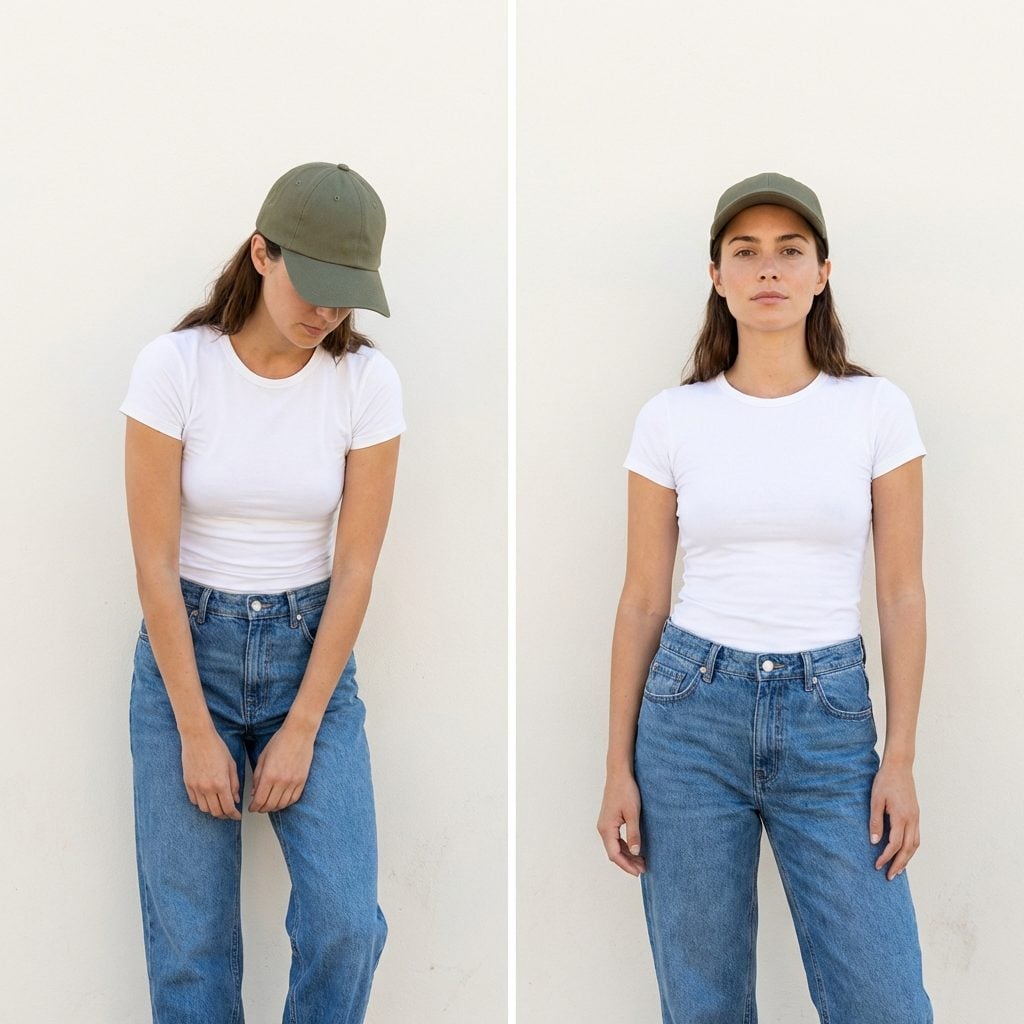
Pull a baseball cap down to the eyebrows, round the shoulders slightly, and avoid eye contact. Now pull it to a clean position just above the ears, square the shoulders, and walk with your chin level. Same cap. Completely different person.
Posture is not a style note, it’s a psychological broadcast. Research by Adam Galinsky and colleagues found that body posture operates independently of social role in activating the implicit experience of power: expansive posture activates power-related cognition even when the clothing or context doesn’t support it. (Source) The reverse is equally true. Constricted posture, rounded shoulders, lowered chin, contracted frame, signals low power to observers and, critically, to the wearer herself.
With a cap, posture carries more visual weight than usual because the cap draws attention upward, toward the face and head. A cap worn with collapsed posture turns the entire look into a retreat. The cap becomes a visor, a shield, something to hide behind rather than frame you. Worn with open posture, the same cap becomes a deliberate frame for the face, which is the only context in which it reads as a choice.
The Psychological Concept That Explains Why Intention Is Visible, Even When You Think It Isn’t

Here’s the concept that ties every piece of this puzzle together: enclothed cognition. In the now-famous 2012 study by Hajo Adam and Adam D. Galinsky, participants who wore a lab coat described as a doctor’s coat showed significantly higher sustained attention than those wearing the identical coat described as a painter’s coat. The clothing was the same. The symbolic meaning, and the intention behind wearing it, changed everything. Source
The principle extends far beyond lab coats. (Source) examining 105 effects across 40 studies affirmed the core principle: what we wear influences how we think, feel, and act, and by extension, how that state is read by others. When you put on a cap as a replacement for effort, your body knows. Your posture reflects it. Your expression reflects it. The styling choices around it reflect it. Intention isn’t a private mental event, it leaks into every decision you make getting dressed.
This is why observant women see the difference so clearly. They’ve made the same calculation: cap as camouflage, or cap as choice. They know the coordinates. The unwashed hair stuffed underneath. The outfit that has no other casual or sporty note. The fit that’s slightly too loose or slightly too tight. The bare face. None of these details is the real signal. The real signal is the aggregate, the sum of all the small decisions that reveal whether someone dressed with intention or against it. The cap is just where it shows up most clearly.
“The cap is never the mistake. The absence of intention in everything surrounding it is the mistake, and every woman who’s made that choice herself can read it instantly.”
The Bottom Line
The mistake isn’t the cap, it’s the absence of one finished detail anywhere else in the look. When nothing is resolved, no defined brow, no considered earring, no deliberate posture, the cap reads as avoidance, and every woman who has ever used one that way recognizes it instantly. Before you leave the house, ask yourself: what is the one thing I completed today?